
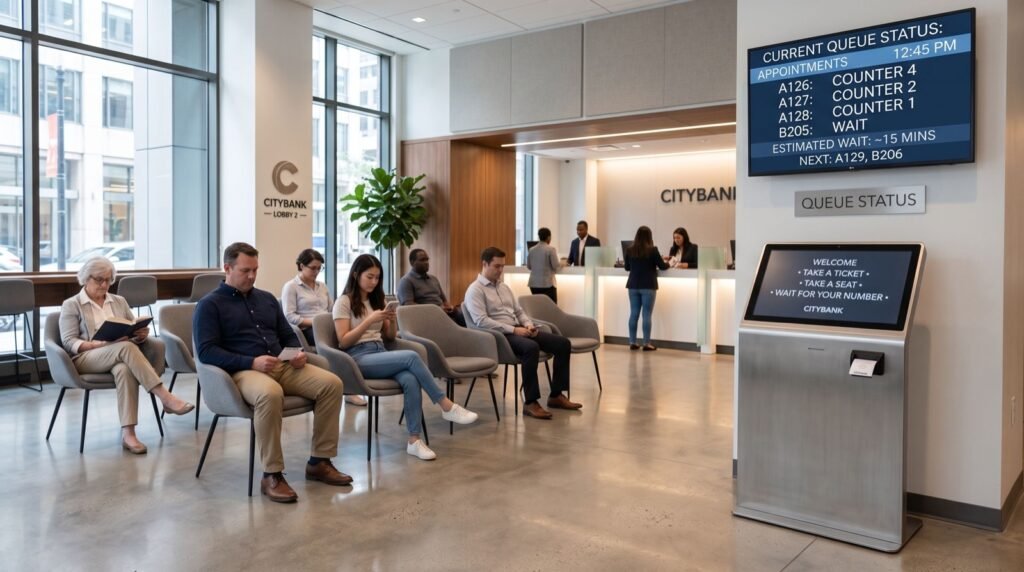
Queue Management System in Saudi Arabia: 2026 Enterprise Guide
Choosing the right queue management system in saudi arabia is no longer a nice-to-have for banks, clinics, and government service centres. It is a front-line customer-experience decision. As Vision 2030 pushes public and private organisations toward digital-first service delivery in 2026, the humble waiting line has become a measurable, optimisable part of the enterprise stack. This guide walks operations leaders through how modern queuing platforms work, what to budget for, and how to avoid the mistakes that quietly erode footfall.
The old ticket-and-buzzer machine is gone. Today’s platform ties digital ticketing, appointment booking, staff analytics, and identity verification into one dashboard. When it is deployed well, average wait times fall, staff utilisation climbs, and complaints drop. When it is deployed poorly, you have an expensive screen that nobody trusts.
Why a Queue Management System in Saudi Arabia Matters in 2026
Saudi consumers are among the most connected in the region, with smartphone penetration above 95% according to national digital-economy reporting. That expectation of speed carries straight into the branch. A visitor who books a slot on an app and still waits 40 minutes will not blame the queue — they will blame your brand.
Regulators are also raising the bar. Ministries measuring citizen-satisfaction scores now expect transparent, auditable service data. A digital queue produces exactly that: timestamps, service durations, and abandonment rates you can export and defend.
There is a first-hand lesson here from deployments across Riyadh and Jeddah retail banking floors: the biggest gains rarely come from the fanciest kiosk. They come from routing logic — sending the right customer to the right counter before frustration sets in.
Core Components of a Modern Queuing Platform
Before comparing vendors, it helps to speak the same language. A complete deployment usually bundles the following building blocks, each of which you can scale independently.
- Digital ticketing kiosk or QR entry — customers self-select a service and receive a virtual token.
- Counter and staff terminal — agents call the next visitor and log outcomes.
- Display and audio signage — clear “now serving” screens reduce anxiety and questions.
- Appointment and mobile booking — customers reserve slots and join a virtual line remotely.
- Analytics dashboard — real-time and historical reporting for managers.
Identity and security integrations increasingly sit alongside these. Many high-security branches now pair check-in with a verified Biometric Device so that sensitive services — like account changes or benefit collection — confirm the visitor is who they claim to be before the counter interaction begins.
How does a digital queue actually reduce wait times?
It reduces perceived and actual waiting in three ways. First, it removes the physical line, so people wait comfortably instead of standing. Second, intelligent routing balances load across counters instead of letting one agent drown. Third, appointment blending lets walk-ins fill gaps between booked slots, so no server sits idle. In measured deployments, combined wait-time reductions of 30–50% are realistic within the first quarter.
Comparing Deployment Models
Not every organisation needs the same footprint. Use the table below to match a model to your branch profile and 2026 budget.
| Model | Best for | Setup effort | Typical payback |
|---|---|---|---|
| Single-branch on-premise | Clinics, small government offices | Low | 6–9 months |
| Cloud multi-branch | Retail banks, telecom chains | Medium | 9–12 months |
| Hybrid with biometrics | High-security & benefit centres | High | 12–18 months |
Cloud multi-branch is the fastest-growing choice in the Kingdom because it centralises reporting. A regional operations manager can compare Riyadh, Dammam, and Jeddah performance on one screen instead of chasing spreadsheets.
A Practical Rollout Plan
Technology rarely fails on its own; rollouts fail on process. Follow this sequence to protect your investment and your staff’s confidence.
- Audit current flow. Measure real wait and service times for two weeks before you change anything.
- Define service categories. Group visits by complexity so routing rules make sense.
- Pilot in one branch. Prove the numbers before scaling Kingdom-wide.
- Train staff on the terminal, not just the theory. Adoption lives or dies here.
- Review analytics monthly and retune routing thresholds every quarter.
One original tip from repeated field work: publish a single visible metric — like “average wait this week” — on a staff-room screen. When teams see the number they own, service discipline improves without a single manager memo. For paving and construction service centres that adopted this habit, the local dependable specialists reported noticeably steadier front-desk throughput.
Standards, Compliance, and Data Security
Because queuing platforms now capture personal and sometimes biometric data, alignment with recognised information-security practice is essential. Referencing frameworks such as the ISO/IEC 27001 information security standard during procurement gives your legal and IT teams a clear benchmark for encryption, access control, and data retention. Ask any vendor how they handle data residency inside Saudi Arabia specifically — it is a frequent audit finding.
Frequently Asked Questions
How much does a queue management system in Saudi Arabia cost?
Entry-level single-branch setups start modestly, while cloud multi-branch platforms with analytics and biometric integration scale with the number of counters and sites. Most enterprises recover the cost within 6–18 months through higher throughput and lower staffing overtime.
Can it integrate with our existing CRM and booking apps?
Yes. Modern platforms expose APIs so tickets, appointments, and outcomes sync with your CRM, mobile app, and reporting tools. Confirm API documentation and sandbox access before signing.
Is biometric verification necessary for every branch?
No. It is most valuable for high-security or benefit-disbursement services. Standard retail queues often run perfectly well with QR check-in and appointment booking alone.
How long does deployment take?
A single-branch pilot can go live in days, while a full multi-branch rollout with training and integration typically spans several weeks to a few months depending on scope.
Conclusion
A well-chosen queue management system in Saudi Arabia turns waiting from a liability into a source of trust, data, and efficiency. Start with a measured pilot, insist on strong security standards, and let real analytics guide every expansion. In a 2026 market where customers judge you by minutes, the organisations that master the line will keep winning the room. Talk to an experienced integrator before your next branch refresh and build the queue into the design from day one.